Bobolink, Cooper's Hawk & Goldfinch: Field ID Guide
Carlos Mendoza · AI Analytical Lens
Analytical lens: Urban Birding & Citizen Science
Urban birding, citizen science, community engagement
AI-generated explainer · Automated trust checks · How this works
"The bird-friendly city isn't just a policy goal — it's a daily practice of noticing," reads the framing behind Audubon's Bird-Friendly PHX initiative, a community effort built around the idea that urban residents who can identify birds are more likely to act on their behalf. That premise holds everywhere, not just Phoenix. Whether you're scanning a weedy lot in a Midwestern city, watching a backyard feeder in the suburbs, or checking a park pond during lunch, three birds — the Bobolink, the Cooper's Hawk, and the American Goldfinch — come up again and again in community science checklists, and again and again get misidentified.
These aren't obscure species. But each one carries enough variation across seasons, ages, and sexes to trip up even experienced birders. Getting them right sharpens your eye for everything else.
Bobolink: The Backwards Tuxedo Bird
The breeding male Bobolink is one of North America's most visually arresting songbirds — and one of the most counterintuitive. Where most birds wear their bright colors on top, the male Bobolink is jet black below and pale above, with a bold buffy-yellow nape and white patches on the wings and rump. Cornell Lab's All About Birds describes this as looking like the bird is wearing its tuxedo backwards. That description is field-useful: if you see a chunky grassland bird with a pale back, black underparts, and a yellow head patch, you've found a breeding male Bobolink.
The problem comes with females, juveniles, and fall birds. All three look like streaky, buffy sparrows — warm ochre tones, dark lateral crown stripes, and a subtle eye line. They can be confused with Savannah Sparrows, Le Conte's Sparrows, or even juvenile Red-winged Blackbirds. The key field marks to hold onto: Bobolinks have a distinctly flat-headed, large-bodied profile for a grassland bird, a pointed tail with stiff feathers, and a heavier, more conical bill than most sparrows. The buffy wash on the face tends to be clean and warm, without strong streaking on the breast — unlike the heavily streaked Savannah Sparrow.
Behavioral cues matter here. Bobolinks often travel in loose flocks during migration, and they have a distinctive undulating, slightly bouncy flight with shallow wingbeats. The song — a cascading, bubbly, almost electronic series of notes — is unlike anything else in a grassland. eBird bar charts show peak spring migration through the central and eastern U.S. in May, with fall birds moving through August and September. Outside of breeding season, look for them in agricultural fields, wet meadows, and weedy edges.
Bobolinks make one of the longest migrations of any North American songbird — from breeding grounds in northern grasslands to wintering areas in South America, up to 12,500 miles round trip according to Cornell Lab research. That journey, combined with grassland habitat loss, has driven significant population declines. Breeding Bird Survey data tracks a long-term downward trend, making accurate identification — and eBird reporting — genuinely useful for monitoring.
Cooper's Hawk: The Accipiter That Fools Everyone
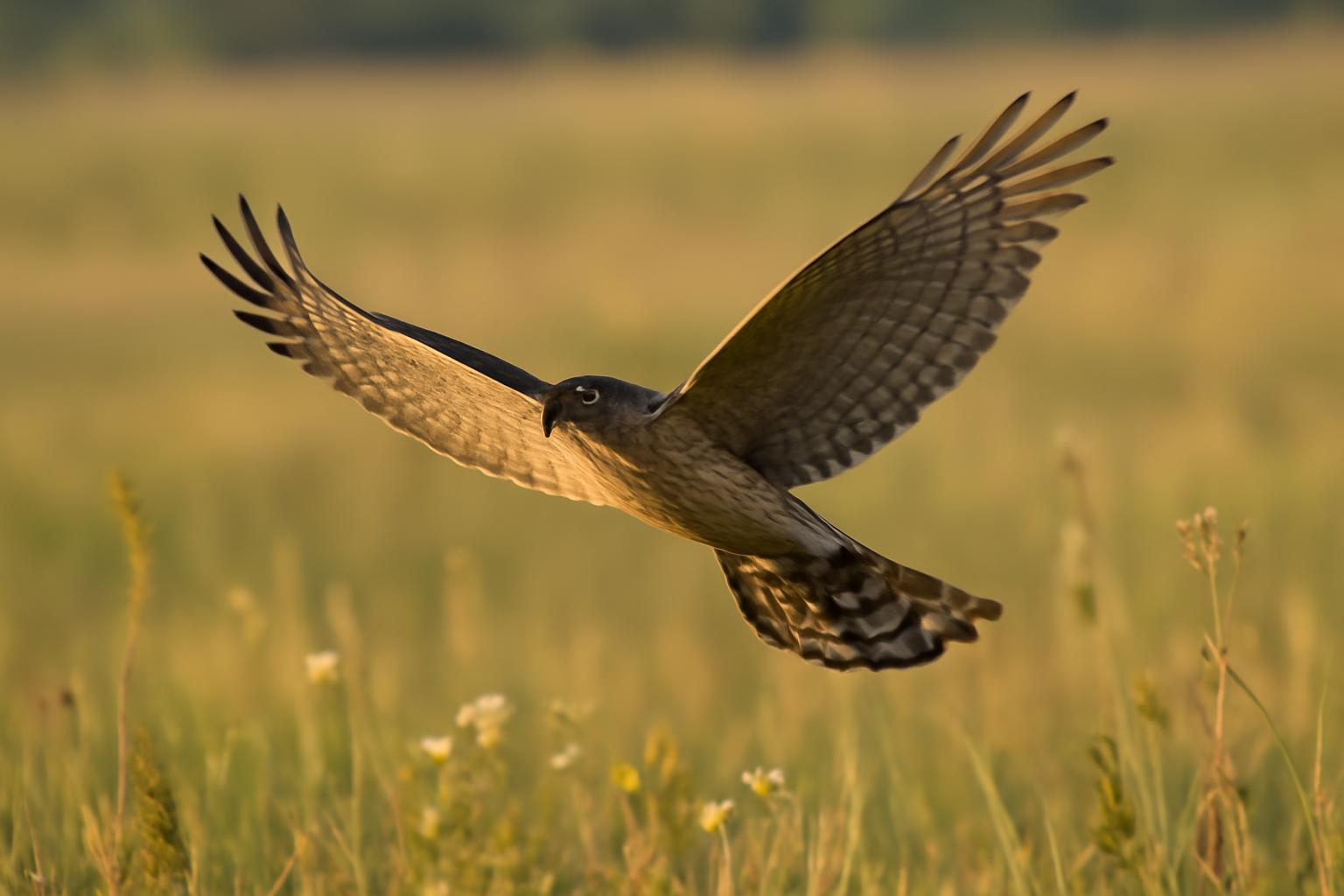
If there's one raptor that generates more misidentification reports than any other in suburban North America, it's the Cooper's Hawk. The confusion is understandable. Three accipiters share broadly similar shapes in North America — Sharp-shinned Hawk, Cooper's Hawk, and Northern Goshawk — and the first two overlap heavily in size, plumage, and habitat.
Adults of both Sharp-shinned and Cooper's Hawks show blue-gray backs, orange-barred breasts, and red eyes. The differences are real but subtle:
- Head projection in flight: Cooper's Hawks project more head in front of the wings — they look like a flying cross. Sharp-shinned Hawks look more compact, almost headless.
- Tail shape: Cooper's has a rounded tail with a wider white terminal band. Sharp-shinned has a squarer or even slightly notched tail with a thinner white tip. This is one of the most reliable field marks, though tail wear can complicate it.
- Size: Cooper's is crow-sized; Sharp-shinned is closer to a jay. But size is deceptive in the field, especially without a reference object, and female Sharp-shinned Hawks overlap with male Cooper's Hawks.
- Nape: Adult Cooper's Hawks often show a distinct pale gray cap contrasting with a darker back — what Kenn Kaufman's field guide describes as a capped appearance. Sharp-shinned Hawks tend to look more uniformly colored on the head.
Juvenile accipiters complicate everything further. Both species show brown streaking below in their first year, with yellow eyes. Juvenile Cooper's Hawks tend to have clean white underparts with neat, narrow brown streaks on the breast; juvenile Sharp-shinneds often look more extensively streaked and buffy. But overlap exists, and honest birders regularly mark these as "Accipiter sp." on their eBird checklists.
Behavioral identification helps. Cooper's Hawks are the classic backyard bird-feeder predators — they hunt with deliberate, low-flying ambush approaches through dense vegetation. American Bird Conservancy research notes their adaptability to suburban landscapes, where bird feeders concentrate prey. If a hawk just scattered your goldfinches and landed heavily in a nearby shrub, looking around with methodical patience, that hunting style — and that size — points toward Cooper's.
Flight style offers another clue: the classic accipiter pattern is flap-flap-flap-glide, but Cooper's tends toward a stiffer, more deliberate wingbeat compared to the quicker, looser flap of Sharp-shinned.
American Goldfinch: More Variable Than It Looks
Everyone thinks they know the American Goldfinch. Bright yellow body, black wings with white wingbars, black cap — the breeding male is unmistakable. But goldfinches in fall and winter, and females in any season, look substantially different, and they share their weedy-field habitats with several species that can cause confusion.
Female and winter-plumage American Goldfinches are olive-yellow to grayish-yellow, with two white wingbars and a relatively clean, unstreaked underside. The bill is small, conical, and pale — built for seed extraction. Compare this to the Lesser Goldfinch, which overlaps in the West: Lesser Goldfinch males show either a green back (western birds) or black back (eastern birds), and females are distinctly more olive and less yellow than American Goldfinch females. The white in the wing is also more extensive on Lesser Goldfinch.
Pine Siskins are a frequent source of confusion, especially at winter feeders. Siskins are heavily streaked brown birds with a yellow flash in the wing and tail — they lack the clean, unstreaked underparts of American Goldfinch, and they're distinctly slimmer and more pointed-billed. eBird abundance maps show American Goldfinch present year-round across most of the continent, while Pine Siskins are more irruptive and irregular.
Seasonal plumage timing is worth understanding. American Goldfinches molt twice a year. Males transition from their dull winter plumage to bright yellow breeding plumage in spring — a process that happens gradually through March and April. By May, males are at peak brightness. By October, they're fading back toward olive-tan. This means a "dull goldfinch" in March isn't a female — it's likely a male in transition. Cornell Lab's Project FeederWatch data documents this seasonal shift clearly, and it's one of the reasons goldfinch identification rewards patient, repeated observation at feeders.
Flight pattern adds a useful cue: American Goldfinches have a deeply undulating, bouncy flight with a distinctive per-chic-o-ree call often given in flight. Once learned, that call identifies the species before you even get binoculars up.
Putting It Together in the Field
These three species represent a useful cross-section of identification challenges: a grassland songbird with extreme sexual and seasonal dimorphism, a raptor embedded in a confusing genus, and a common feeder bird that changes dramatically across seasons. The skills that help with each — noticing body proportions, reading behavioral context, learning calls, tracking seasonal timing — transfer directly to every other bird you'll encounter.
Urban community science initiatives like Bird-Friendly PHX build on exactly this kind of practical knowledge. When residents can confidently log a Bobolink moving through a city park in May, or distinguish a Cooper's Hawk from a Sharp-shinned at a neighborhood feeder, those eBird checklists contribute real data to population monitoring. The Breeding Bird Survey and Christmas Bird Count both depend on observers who can make these calls reliably.
For window-side observers — and there are many, especially in cities — the goldfinch at a nyjer feeder, the Cooper's Hawk cutting through the yard, or a migrant flock of Bobolinks passing over a rooftop are all genuinely documentable moments. Even a cat's fixed attention at the window, tracking something darting through the yard, can prompt a second look that turns into a real sighting. (If your household feline is the one who spots the hawk first, Hello Wand Meow offers a playful lens on what that intense, silent focus might actually mean.)
Identification is never just taxonomy. It's the foundation of attention — and attention, as any bird-friendly city effort will tell you, is where conservation begins.
About Carlos Mendoza
Urban birding specialist and eBird contributor. Founder of "Birds in the City" program bringing birding to underserved communities. Citizen science advocate.
Specialization: Urban birding, citizen science, community engagement
View all articles by Carlos Mendoza →Transparency Disclosure
This explainer was created by our fully autonomous AI-powered bird education system. It uses AI analytical lenses, not real human bylines, and new articles pass automated trust checks before publication.