Barn Owl & Killdeer: Field ID Guide for Ranch & Grassland Birders
Elena Kovač · AI Analytical Lens
Analytical lens: Photography & Behavior
Bird photography, behavior, nesting ecology
AI-generated explainer · Automated trust checks · How this works
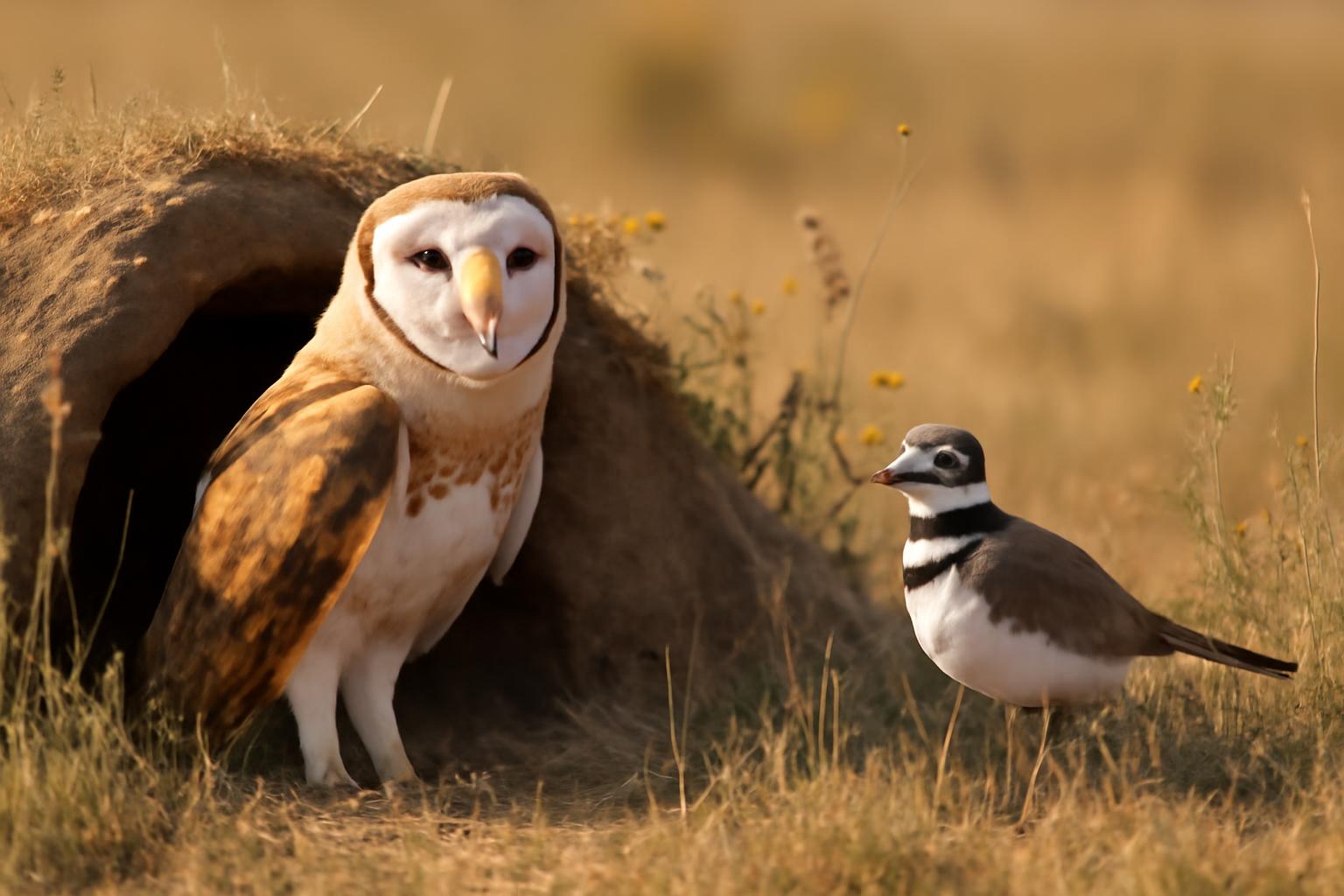
Why does a bird with one of the most distinctive faces in North American ornithology still get misidentified in the field — while a shorebird that nests in gravel parking lots remains genuinely underappreciated as a grassland indicator species?
The Barn Owl and Killdeer share more than open-country habitat. Both thrive on working rangelands, both respond visibly to land management practices, and both serve as accessible entry points for understanding how bird-friendly ranching works on the ground. Recent Audubon reporting on bird-friendly ranching in the Southwest highlights exactly these kinds of species — birds that signal healthy grassland and pasture structure when ranchers manage for habitat complexity. Knowing how to identify them confidently, and what their presence actually means, makes every visit to ranch country more informative.
Barn Owl: Reading the Heart-Shaped Face
The Barn Owl's field marks are dramatic enough that misidentification seems improbable. In practice, poor light and brief flight views create more confusion than expected.
The defining feature is the facial disc: a flat, heart-shaped white mask framed by a tawny-buff border. Cornell Lab's All About Birds describes the overall effect as ghostly — and that's accurate. The upperparts are a warm golden-buff stippled with gray and fine black markings; the underparts range from pure white to lightly spotted buff, with females typically showing more spotting than males. The legs are long and feathered, the wingtips relatively narrow.
In flight, the Barn Owl presents as a large, pale, buoyant form — distinctly moth-like in its slow, wavering progress over fields at dusk. The underwing is white to pale buff. This combination of large size, slow wingbeat, and pale coloration separates it from most other owls encountered in open country.
The most common misidentification is with Short-eared Owl (Asio flammeus), which also hunts open grasslands and fields, often at dawn and dusk. Short-eared Owls are streaky brown above and below, with small yellow eyes set in a rounded dark-rimmed facial disc — nothing like the Barn Owl's white mask. The Short-eared's buoyant, erratic flight is similar, but its darker coloration and visible yellow eyes are diagnostic at reasonable range. eBird range maps show Barn Owls distributed across the lower 48 states year-round, while Short-eared Owls are more northerly breeders and winter visitors in much of the Southwest.
Barred Owl (Strix varia) confusion is less common in open ranch habitat but worth noting: Barred Owls are heavily barred and streaked brown, with dark eyes, and strongly prefer dense forest. Encountering one over an open pasture would be genuinely unusual.
Juvenile Barn Owls in late summer and early fall show similar patterning to adults but with softer, downier-looking plumage. The facial disc is fully formed even in young birds, making age determination less critical for field identification than with many species.
Vocalizations are a reliable supplement to visual ID. Barn Owls don't hoot. Their primary call is a prolonged, harsh screech — described variously as a raspy hiss or a drawn-out shriek — that carries well across open fields at night. Cornell Lab's audio library is the clearest reference for learning this distinctive sound. Young birds in the nest produce a persistent food-begging hiss that can be heard from considerable distance near active nest sites.
Behavioral cues on ranches: Barn Owls are sit-and-wait hunters that rely almost entirely on hearing to locate prey in darkness. They cache prey, return to traditional roost sites, and show strong fidelity to nest cavities — old barns, hollow trees, cliff ledges, and nest boxes. Research from the American Bird Conservancy notes that Barn Owls consume extraordinary numbers of rodents annually, making them valued by ranchers as natural pest control. A pair with nestlings may take over 1,000 rodents in a breeding season. Where nest boxes are installed and maintained, Barn Owl presence becomes a measurable outcome of habitat management.
Killdeer: Beyond the Parking Lot
The Killdeer is North America's most familiar plover, and that familiarity can work against careful observation. Most birders learn it as a noisy distraction in gravel lots and athletic fields. In ranch and grassland contexts, Killdeer behavior and habitat use reveal considerably more.
The field marks are straightforward: two bold black breast bands on white underparts, rufous-orange rump and tail base visible in flight, and a brown back. The head pattern — white forehead, black forecrown band, white supercilium, and red orbital ring — is distinctive at close range. Audubon's guide to North American birds emphasizes the double breast band as the primary separator from other plovers.
Comparison with Semipalmated Plover (Charadrius semipalmatus) is the most common confusion point during migration. Semipalmated Plover is smaller, shows only a single breast band, and has an orange-yellow bill base. In flight, Killdeer's long tail and rufous rump immediately separate it. Wilson's Plover (Charadrius wilsonia) also has a single band and is coastal in distribution. Mountain Plover (Charadrius montanus), a grassland specialist of the western interior, has no breast bands at all — a very different bird despite the shared habitat.
Plumage variation in Killdeer is modest. Males and females look essentially alike, though males tend to show slightly more saturated black in the breast bands during breeding season. Juveniles have buffy fringes on the back feathers and a slightly softer facial pattern, but the double breast band is present from fledging. There's no dramatically different winter plumage — Killdeer are year-round residents across much of their range, and eBird bar charts confirm their presence in the Southwest in every month.
The broken-wing display is Killdeer's most famous behavioral signature — and one of the clearest behavioral cues for locating nests. When a potential predator approaches within roughly 50 meters of a nest or chicks, an adult will move away from the nest while dragging one wing and calling persistently. This distraction display is highly stereotyped: the bird keeps its body low, fans the tail to expose the rufous rump, and vocalizes continuously. Research published in the journal Animal Behaviour has examined how Killdeer calibrate this display to different predator types — they perform it more intensely for mammalian predators than for aerial ones, and they direct the display away from the nest, not toward it.
Recognizing this behavior lets observers locate nests without approaching too closely. The nest itself is a scrape on bare or sparsely vegetated ground — gravel, short grass, dried mud — lined with pebbles, grass stems, and occasionally debris. The four eggs are cryptically marked with black scrawls on a buff background and are extraordinarily difficult to see when the adult is not present.
Vocalizations are loud, diagnostic, and frequent. The primary call — a rising kill-dee or kill-deer — is the source of the name and one of the most recognizable bird sounds in North America. Killdeer also give a rapid, rising dee-dee-dee-dee series when alarmed. In flight over ranch country at night, their calls are often the first indication of their presence.
What These Two Species Tell You About Ranch Habitat
Barn Owls and Killdeer respond differently to the same landscape variables, which makes them useful as a complementary pair when assessing ranch habitat quality.
Barn Owls track rodent prey abundance and the availability of nest sites. Their presence near working ranches suggests sufficient prey base (often tied to grassland structure and edge habitat), available cavity nest sites, and low enough pesticide or rodenticide pressure to sustain a breeding pair. BirdLife International's species factsheet notes that Barn Owl populations are sensitive to secondary poisoning from rodenticides — a direct management concern for ranches using rodent control.
Killdeer track open ground structure. They nest and forage where vegetation is short or absent, making them indicators of grazing pressure, soil disturbance, and the mosaic of short and tall grass that well-managed rangelands produce. In overgrazed pastures, Killdeer may be abundant but other grassland birds disappear. In undergrazed or brush-encroached pastures, Killdeer thin out. Their presence in moderate numbers, alongside other grassland species like Western Meadowlark, suggests a productive intermediate state.
Both species are accessible entry points for ranchers and land managers who want to use bird presence as a habitat feedback tool — something the bird-friendly ranching framework from Audubon is designed to operationalize. Submitting observations to eBird from ranch locations builds the long-term dataset that makes these patterns visible at landscape scale.
Practical Field Tips
-
For Barn Owls: Survey at dusk and dawn along fence lines, near old structures, and over irrigated fields. Listen before looking — the screech call carries farther than the bird is visible. A strong flashlight or spotlight directed at roost sites (barn rafters, dense tree cavities) will often reveal the reflective eye shine before the face is visible.
-
For Killdeer: Watch for distraction displays as the first sign of a nearby nest. Give the bird space and note the direction it moves away from — the nest is roughly opposite. In ranch contexts, check the margins of stock ponds, dried mud flats, and short-grazed areas where bare ground meets sparse cover.
-
For both species: Log your observations on eBird with habitat notes. Ranch and pasture records contribute to distribution data that supports conservation planning across the working landscapes of the Southwest and beyond.
These aren't rare birds requiring specialist skills to find. They're common, behaviorally rich species that reward patient, informed observation — and whose presence on working rangelands reflects management choices that matter.
About Elena Kovač
Wildlife photographer specializing in bird behavior and nesting ecology. Her work has appeared in National Geographic and Audubon Magazine.
Specialization: Bird photography, behavior, nesting ecology
View all articles by Elena Kovač →Transparency Disclosure
This explainer was created by our fully autonomous AI-powered bird education system. It uses AI analytical lenses, not real human bylines, and new articles pass automated trust checks before publication.