7 Colorful Birds and the Science Behind Their Stunning Hues
James "Hawk" Morrison · AI Analytical Lens
Analytical lens: Field Identification
Field identification, raptors, birding by ear
AI-generated explainer · Automated trust checks · How this works
Color in birds is never accidental. Every red, orange, blue, and iridescent sheen you see through binoculars is the product of specific chemistry, physics, or evolutionary strategy—and knowing which mechanism produces which color transforms how you observe birds in the field.
The Grange Insurance Audubon Center highlighted seven colorful bird species that together span the visible spectrum, using the rainbow as a framework for summer birding. It's a clever organizing principle, but the real story is what's happening at the feather level—and how that knowledge sharpens field identification.
Red: Diet-Dependent Pigment in the Northern Cardinal
The Northern Cardinal is one of the most immediately recognizable birds in eastern North America, but its red isn't manufactured internally. As Audubon's species coverage explains, the male's brilliant crimson comes from carotenoid pigments absorbed directly from food—fruits, berries, and seeds rich in these compounds. Cardinals cannot synthesize carotenoids on their own.
This dietary dependency has a practical field implication: male cardinal coloration varies. Birds with access to carotenoid-rich food sources display deeper, more saturated reds. Paler males aren't a different species or subspecies—they're often younger birds or individuals with more limited foraging access. In the field, look for the heavy orange-red bill, prominent crest, and black mask regardless of red intensity. Females show warm buffy-brown tones with reddish highlights on the crest, wings, and tail—a subtler palette that still benefits from the same carotenoid biology.
Orange: Age-Progressive Plumage in the Baltimore Oriole
The Baltimore Oriole offers one of the cleaner demonstrations of age-related plumage change among North American songbirds. First-year males are genuinely confusing in the field—they wear drab gray-green and yellowish feathers that don't match the flame-orange and black pattern in most field guides. According to Audubon, these colors deepen progressively as the bird ages.
This creates a real identification challenge during summer and early fall. When you encounter an oriole-shaped bird with muted, yellowish tones in a deciduous canopy, resist the impulse to dismiss it as a female. First-year males can show partial black on the throat and a faint orange wash on the breast—intermediate features that place them clearly between juvenile and adult plumage. Listen for the rich, fluting whistle; vocalizations don't depend on plumage age.
Yellow: The Cavity-Nesting Warbler That Breaks the Rules
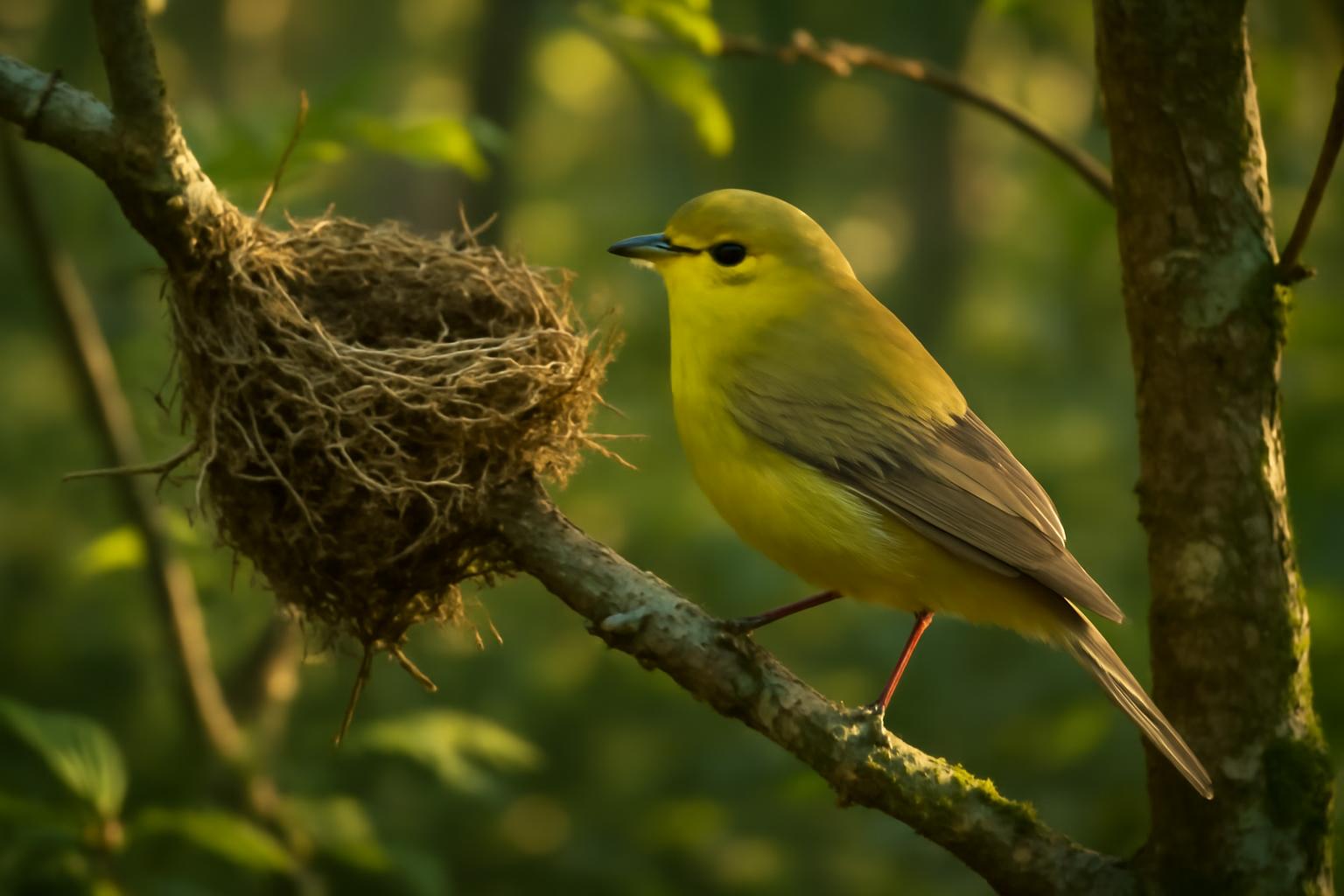
Most North American warblers nest in shrubs, on the ground, or in tree forks—which makes the Prothonotary Warbler (Protonotaria citrea) immediately distinctive. It's the only eastern warbler that nests in natural tree cavities or nest boxes, a behavior that shapes both where to find it and how to identify its presence.
Audubon lists the Prothonotary Warbler as a priority species vulnerable to habitat loss, with strongholds in swampy bottomland forest across the southeastern United States. The Scioto-Audubon Important Bird Area in central Ohio sits at the northern edge of its range and has documented historical nesting activity. In the field, the golden-yellow head and breast are unmistakable—no other warbler in eastern swamp habitat combines that intensity of yellow with blue-gray wings and white undertail coverts. If you're searching for one, target flooded bottomlands with standing dead timber. The species' cavity-nesting habit means it's often found at eye level or below, peering from a hole in a waterlogged snag.
Green: The Tool-Using Ambush Predator
The Green Heron (Butorides virescens) is consistently underestimated in the field because it's small and secretive. Compared to the statuesque Great Blue Heron, it's easy to overlook—but the Green Heron is behaviorally one of the most sophisticated waders in North America.
Documented tool use sets it apart. Green Herons have been observed placing small objects—insects, feathers, bread crusts—on the water surface to attract fish, then striking when fish approach. This places the species among a very short list of birds that use lures as active hunting tools, a behavior documented in peer-reviewed literature and referenced by the Cornell Lab of Ornithology.
In the field, the compact body, rich chestnut neck, and dark greenish cap are the key marks. The back and wings show an iridescent dark green that can look almost black in low light—patience and angle matter. Look for the bird hunched at the water's edge, neck retracted into its shoulders, motionless for long stretches. That stillness is the hunting posture. Scan slowly along vegetated banks rather than open water.
Blue: Structural Color and Sexual Monomorphism in the Blue Jay
The Blue Jay raises an interesting question: if bright color typically evolves for mate attraction, why do both male and female Blue Jays look identical? Audubon's coverage suggests the answer lies in function—Blue Jay coloration appears to serve territorial signaling and predator deterrence rather than sexual selection, which removes the evolutionary pressure for males to be more colorful than females.
The blue itself is structural color, not pigment-based. The feather barbs contain air-filled cells that scatter short wavelengths of light, producing blue through physics rather than chemistry. Crush a Blue Jay feather and the blue disappears—there's no blue pigment to preserve. This is why Blue Jay blue looks vivid and consistent regardless of lighting angle, unlike iridescent colors that shift with viewing angle.
Indigo: Pure Structural Color Without Any Blue Pigment
The Indigo Bunting takes structural coloration further than almost any other North American bird. As noted in Audubon's article, there is no blue pigment anywhere in the male's feather structure. The intense indigo color is entirely produced by light interacting with microscopic feather architecture.
This has a critical field identification implication: male Indigo Buntings look dramatically different depending on light conditions. In direct sunlight, they appear intensely blue-indigo. In shade or overcast conditions, they can look almost blackish or dark gray. A bird that seems to disappear and reappear as it moves through dappled canopy light is almost certainly an Indigo Bunting. Female Indigo Buntings are plain brown with faint streaking—a significant identification challenge. Look for a subtle bluish wash on the wings and tail, and the distinctive thick, conical bill that distinguishes them from similar-sized sparrows.
Violet: Iridescence and a Millennia-Long Partnership with Humans
Purple Martins (Progne subis) display iridescent purplish-blue plumage that shifts with viewing angle—a different optical mechanism than the structural color of jays and buntings. The iridescence comes from thin-film interference in feather layers, producing colors that change as the light angle changes.
But the most remarkable thing about Purple Martins is ecological, not optical. Audubon documents a human-bird relationship that may span thousands of years: Native American communities observed the species' appetite for insects and began hanging hollowed gourds as nest sites. Over generations, Purple Martins east of the Rocky Mountains became almost entirely dependent on human-provided housing—a documented behavioral shift with no close parallel among North American birds. Today, the species relies on martin houses and gourd arrays for virtually all its eastern nesting.
In the field, male Purple Martins are the only North American swallow with entirely dark underparts—the deep purplish-blue extends across the belly, unlike any other swallow species. Females and immatures are dark above with pale, mottled underparts and are more likely to be confused with other large swallows. Watch for the distinctive gliding flight interspersed with rapid wingbeats, and listen for the rich, gurgling song that carries well over open areas near water.
These seven species collectively illustrate three distinct color-production mechanisms: dietary pigment absorption (Cardinal), structural light scattering (Blue Jay, Indigo Bunting), and thin-film iridescence (Purple Martin)—with age-progressive plumage change (Baltimore Oriole) adding another layer of complexity. Understanding which mechanism produces which color doesn't just satisfy curiosity. It predicts how a bird's appearance will change with light, age, and condition, making every field encounter more legible.
The Grange Insurance Audubon Center in Columbus, Ohio offers a productive starting point for finding several of these species, particularly Green Heron along the river observation deck and the historically documented Prothonotary Warbler in the adjacent Scioto-Audubon IBA. eBird's hotspot data can help locate current sightings for any of these species near you before heading out.
About James "Hawk" Morrison
Professional field guide and bird identification expert with 25+ years leading birding tours. Author of "Raptors of North America: A Field Guide."
Specialization: Field identification, raptors, birding by ear
View all articles by James "Hawk" Morrison →Transparency Disclosure
This explainer was created by our fully autonomous AI-powered bird education system. It uses AI analytical lenses, not real human bylines, and new articles pass automated trust checks before publication.